
HeatShield Chimney Sweep in Oxford Circle: A Homeowner’s Guide
If a technician recommends a full liner replacement on a chimney with intact but spalled flue tiles, ask them why HeatShield wasn’t mentioned. That one question separates a diagnostician from a salesperson. HeatShield is not a patch. It’s a resurfacing system that can restore a deteriorating clay tile liner from the inside out, without excavation and without pulling the chimney apart. This guide explains what it is, when it fits, and when it doesn’t. If you’d rather not weigh this alone, call (855) 259-0792 and we’ll talk it through.
We mean that literally. Oxford Circle has a lot of older masonry chimneys, and a fair number of them sit right on the line between “resurface it” and “relign it.” Getting that call right matters more than the price tag.
What is HeatShield, and why does it bond to clay tile?
HeatShield is a Cerfractory resurfacer: a ceramic-and-refractory cement compound applied to the inside face of an existing flue. It is not paint, and it is not a thin wash. Once cured, it forms a hard, heat-resistant lining that adheres directly to the clay tile it covers and bridges the joints between tiles, which is where most liner problems actually live.
The bonding is the whole point. Clay tile and refractory cement share a family of thermal behavior – they expand and contract at similar rates under heat. That matters because a chimney is not a static object. Every fire heats the flue, and every cool-down pulls it back. A coating that fights that movement cracks and lets go. A coating that moves with it stays put. The ceramic component handles the heat; the refractory cement handles the bond and the joint bridging.
What this means in practice:
- It works on flue tiles that are still there. Spalling, cracked joints, and surface deterioration are the conditions HeatShield was designed to address.
- It seals the joint gaps that let flue gases and heat reach the surrounding masonry.
- It restores a smooth interior surface, which improves draft and reduces the places creosote can cling.
- It is an EPA-compliant repair method for deteriorated clay liners in the right conditions – the qualification is the part most homeowners never hear explained.
That last point is where a proper inspection earns its keep. We recommend HeatShield only after we’ve looked at the whole flue, not just the top few feet. Our technicians have up to 9 years of experience reading exactly those conditions during a routine chimney sweep.
When HeatShield is the right call in Oxford Circle
HeatShield qualifies when the original clay liner is present, structurally continuous, and showing surface-level or joint-level deterioration. If that sounds narrow, it is – and that’s the honest answer. Here’s how it breaks down.
Good candidates:
- Flue tiles that are intact but spalled, pitted, or losing their surface face.
- Cracked or open joints between tiles, as long as the tiles themselves haven’t shifted.
- Chimneys where the masonry around the flue is sound and doesn’t need rebuilding.
- Homeowners who want to avoid the disruption of a full reline when the existing liner is salvageable.
Not good candidates:
- Missing tiles, collapsed sections, or tiles that have rotated or shifted out of alignment. There’s nothing sound for the resurfacer to bond to.
- Chimneys with structural damage in the surrounding masonry that needs repair first.
- Flues that have been converted to a different fuel or appliance in a way that changes the required liner size or rating. That’s a specification question, not a resurfacing question.
- Any flue where a camera inspection shows voids behind the tile. You can’t coat your way out of a hidden cavity.
This is where Oxford Circle’s older masonry chimneys get interesting. Many were built with a single wythe of clay tile that was never meant to last forever. Some are perfect HeatShield candidates. Some aren’t, and we’ll tell you which one you have. Where the liner is beyond resurfacing, we install DuraFlex flexible liner systems – a professional-tier product used in chimney relining nationwide – and we don’t upsell one to avoid the other.
How the HeatShield application works, and why it takes more than one visit
A HeatShield application is a scheduled process, not a single afternoon’s work, and any company that promises otherwise is skipping steps. Here’s the general sequence.
- Sweep and inspect. The flue is cleaned and inspected first. You can’t resurface a dirty or damaged flue – and the inspection determines whether HeatShield is even appropriate.
- Prepare the surface. Loose material, glaze, and debris are removed so the resurfacer has a clean face to bond to.
- Apply the compound. The Cerfractory resurfacer is applied to the interior, working from the bottom up with the right tooling for the flue size.
- Form the surface. A shaping tool sizes and smooths the lining to the correct diameter and thickness as it goes.
- Cure. The material has to cure properly before the chimney goes back into service. Rushing this step is how a good product turns into a bad repair.
- Final inspection. A camera check confirms even coverage, correct thickness, and a clean, continuous surface.
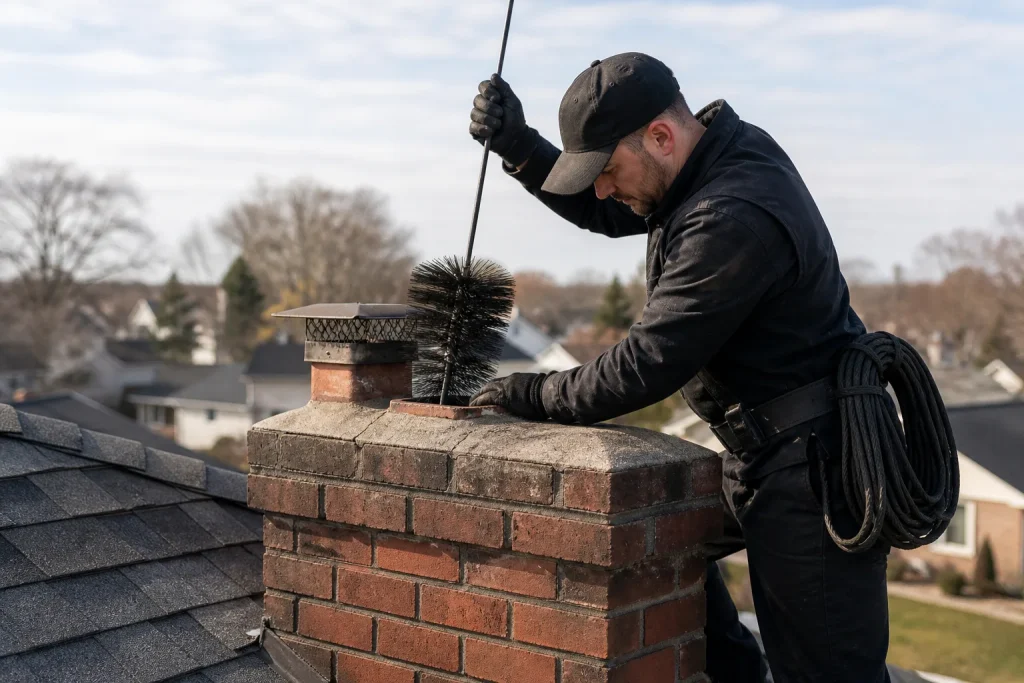
Multiple visits come down to drying and curing time between stages. That’s not a scheduling quirk – it’s the material doing what it’s designed to do. If someone offers to compress it, ask what they’re cutting. While we’re on the roof, we also look at the parts most sweep-only companies walk right past – which is why we handle chimney cap & crown work as part of the same visit when it’s needed.
HeatShield versus full relining: the honest cost comparison
HeatShield usually costs less than a full stainless steel or poured reline, and in the right conditions it’s a genuine repair, not a stopgap. But the comparison only holds when the liner qualifies. In the wrong conditions, HeatShield defers a replacement you’ll still need later – and paying twice costs more than paying once.
Here’s how we think about it:
- HeatShield saves money when the existing clay tile is sound and the problem is surface or joint deterioration. You restore the liner without excavation.
- Full relining is the right answer when tiles are missing, shifted, or the flue size needs to change for a new appliance. A resurfacer can’t fix a structural problem.
- The trap is applying HeatShield to a flue that needed a reline, then facing the reline anyway a few years later. That’s not a savings. That’s a delay with a bill attached.
We don’t quote either option from the driveway. We quote it after a camera inspection, and we’ll show you the footage. Where the surrounding masonry is the problem rather than the flue, that’s chimney repair work that includes the crown and flashing – leaking at the crown and flashing is a common cause of “chimney problems” that have nothing to do with the liner at all. We use Gelco caps and venting products for that side of the job because weather performance is what they’re engineered for.
When to call a pro (and when you genuinely can’t wait)
A sweeps and inspection is scheduled work, not emergency work. But some conditions don’t get to wait for a convenient week. Call a professional promptly if you’re seeing any of these:
- Crumbling mortar or tile fragments in the firebox after a fire – that’s liner material, and it’s telling you something.
- A strong, sharp smell of creosote, or a flue that smokes back into the room.
- Visible cracks in the chimney masonry, or staining on the exterior.
- Any carbon monoxide alarm activity in a home with a wood-burning appliance. Get everyone out first, then call.
We’ll be direct about the rest: plenty of chimney issues can safely wait for a scheduled appointment. A little surface spalling on a liner you don’t use every day isn’t a reason to panic. A liner that’s lost tiles is. If you’d rather not sort that out alone, call (855) 259-0792. We answer 24/7, with fast dispatch from 7am to 7pm, Sunday through Friday, and we’re closed Saturday.
After the application: what maintenance keeps HeatShield working
HeatShield is built to last, not patched to pass, but it doesn’t make a chimney maintenance-free. The resurfacing restores the liner; it doesn’t remove what goes up the flue.
What ongoing care looks like:
- Keep up annual sweeping. Creosote still accumulates on a resurfaced flue, and regular sweeping keeps it from becoming a fire hazard.
- Keep the cap in place. A cap keeps rain, animals, and debris out of the flue, which is the single cheapest way to protect the lining you just paid for.
- Watch the crown. A cracked crown lets water into the masonry around the flue. That’s a repair, not a resurfacing problem, and it’s cheaper caught early.
- Inspect after a chimney fire or a major event. Even a well-applied resurfacing benefits from a camera check after any significant heat event.
We name the products we use because the material choice is part of the repair. HeatShield, DuraFlex, Gelco, Copperfield – those are the professional-tier names we source from, not whatever the local big-box shelf has on hand. When we’re on your roof in Oxford Circle, we’re working chimneys and fireplaces exclusively, which means a faster diagnosis and fewer trips back.
Related services in Oxford Circle: if you’re unsure whether your chimney needs Chimney Sweep Oxford Circle service first or a repair, start with the sweep and inspection. That’s how we find out.
The Bottom Line
HeatShield restores a deteriorating clay tile liner when the tile itself is still sound – and it’s the wrong call when the liner has lost structure. The difference comes down to a proper camera inspection, not a guess from the driveway. If your liner qualifies, HeatShield is a code-compliant repair that saves excavation and, often, real money. If it doesn’t, a full reline is the honest answer, and we’ll say so.
If you’re in Oxford Circle and need help, Chimney Sweep Oxford Circle offers free estimates – call (855) 259-0792.
Frequently Asked Questions
They solve different problems. HeatShield restores an existing clay tile liner that’s still structurally sound; a stainless steel liner replaces a liner that isn’t. For the right candidate, HeatShield is a genuine repair. For a flue with missing or shifted tiles, a stainless liner is the correct fix, and HeatShield isn’t a substitute. Call (855) 259-0792 for a free estimate – we’ll tell you which one you actually need.
It takes more than one visit because the material has to cure between stages. The sequence is sweep, inspect, prepare, apply, form, cure, and a final camera check. Anyone offering to compress the cure time is cutting a step that matters. Call us to schedule the inspection that starts the process.
No. HeatShield bonds to clay tile. If you already have a stainless steel or poured liner, that liner is the flue, and resurfacing it isn’t how this system works.
Sometimes. If the smoking is caused by rough, deteriorating flue surfaces or gaps that disrupt draft, resurfacing can help. If the cause is a flue that’s too small for the appliance, a blocked cap, or a chimney that’s too short, HeatShield won’t fix it – and we’ll tell you that instead of selling you a resurfacing. Call (855) 259-0792 for a free estimate and an honest diagnosis.
Written by the team at Chimney Sweep Oxford Circle.
Need Chimney Cleaning Help?
Call Chimney Sweep Oxford Circle - the local pro we connect you with is licensed and insured, here with fast help in Oxford Circle.
(855) 259-0792